From Vision to Pattern – Translating the Design Into Form
Every couture gown begins as a conversation. Before a single seam is sewn, the atelier gathers detailed measurements – sometimes upwards of thirty – alongside notes on posture, how the bride moves, and what she wants to feel on the day.
Sketch to Silhouette
Early sketches are exploratory rather than final. Neckline depth, train length, and bodice structure are tested on paper first, with the understanding that almost everything will shift once fabric enters the picture.
Draping on the Stand
Fabric is pinned and shaped directly onto a dress form calibrated to the bride's measurements. Draping reveals how a silhouette actually behaves in three dimensions – something no flat sketch can fully predict.
The Toile Stage
A toile, cut in inexpensive muslin, is where proportion is interrogated. Sleeve placement, waist position, and train fall are all refined here, before precious fabrics are ever touched.
Choosing Fabrics and Building the Gown's Hidden Architecture
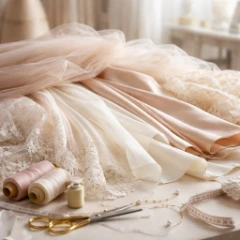
Every fabric decision shapes how a gown moves, catches light, and feels against the skin. Silk satin offers weight and luminosity. Organza adds structure without opacity. Tulle creates volume that breathes. These materials are rarely used alone – layers interact, and an atelier must understand how each fabric behaves against another before cutting a single piece.
Selecting Fabrics for Structure, Movement and Weight
Crêpe drapes close to the body and suits cleaner silhouettes. Lace requires a base layer to give it shape and prevent distortion. Choosing wrong means a gown that photographs beautifully but pulls uncomfortably by the reception. Experienced cutters handle delicate textiles with particular care – some laces are so fine they cannot be pinned without leaving permanent marks.
The Invisible Engineering Beneath
Boning, internal corsetry, underwired cups and carefully placed seams do the structural work most guests never see. Weight distribution matters enormously in full-skirted gowns – without proper layering and support, volume becomes burden. The hidden architecture is what allows a gown to hold its form through an entire day without the bride constantly adjusting it.
Fittings, Final Construction and the Difference Couture Makes
Each fitting reveals something a flat pattern never could. The way a bride holds her shoulders, the length of her stride, the depth of her breath – these shape the gown as much as any initial measurement.
Why Multiple Fittings Matter
A made-to-measure gown typically requires three to five fittings. The first, usually in toile, tests proportion and structure. Subsequent appointments refine the bodice, redistribute weight across the skirt, and address the hem and train length as the bride moves naturally rather than standing still.
Balancing Volume and Wearability
A full skirt that photographs beautifully can feel impossible to walk in. Skilled atelier work resolves this through careful layering and weight distribution, ensuring volume reads as effortless rather than cumbersome.
Hand Finishing and Quality Control
Hand-finished seams, pressed layers, and final embellishment placement come last. Every edge is checked. True couture is always revealed here, in the details no one sees but the bride will feel every moment she wears it.
Every Couture Gown is Made With Intention
What you hold at the end of this process is not simply a dress. Sketches become patterns, patterns become toiles, and toiles become something fitted precisely to your body. Fabric is chosen for how it moves, how it holds structure, how it catches light. Hidden boning, layered underskirts and weighted hems are engineered so the gown wears beautifully without strain. Each fitting refines the silhouette further. Hand-finished seams, pressed edges and final quality checks ensure nothing is left to chance. There's no denying that a gown made this way carries something a ready-to-wear piece simply cannot – the quiet confidence of knowing every detail was considered with you in mind, and made to last well beyond the day itself.